For most of the nuclear industry’s history, the customer was predictable: a regulated utility supplying electricity to homes, businesses and industry.
Artificial intelligence is changing that model.
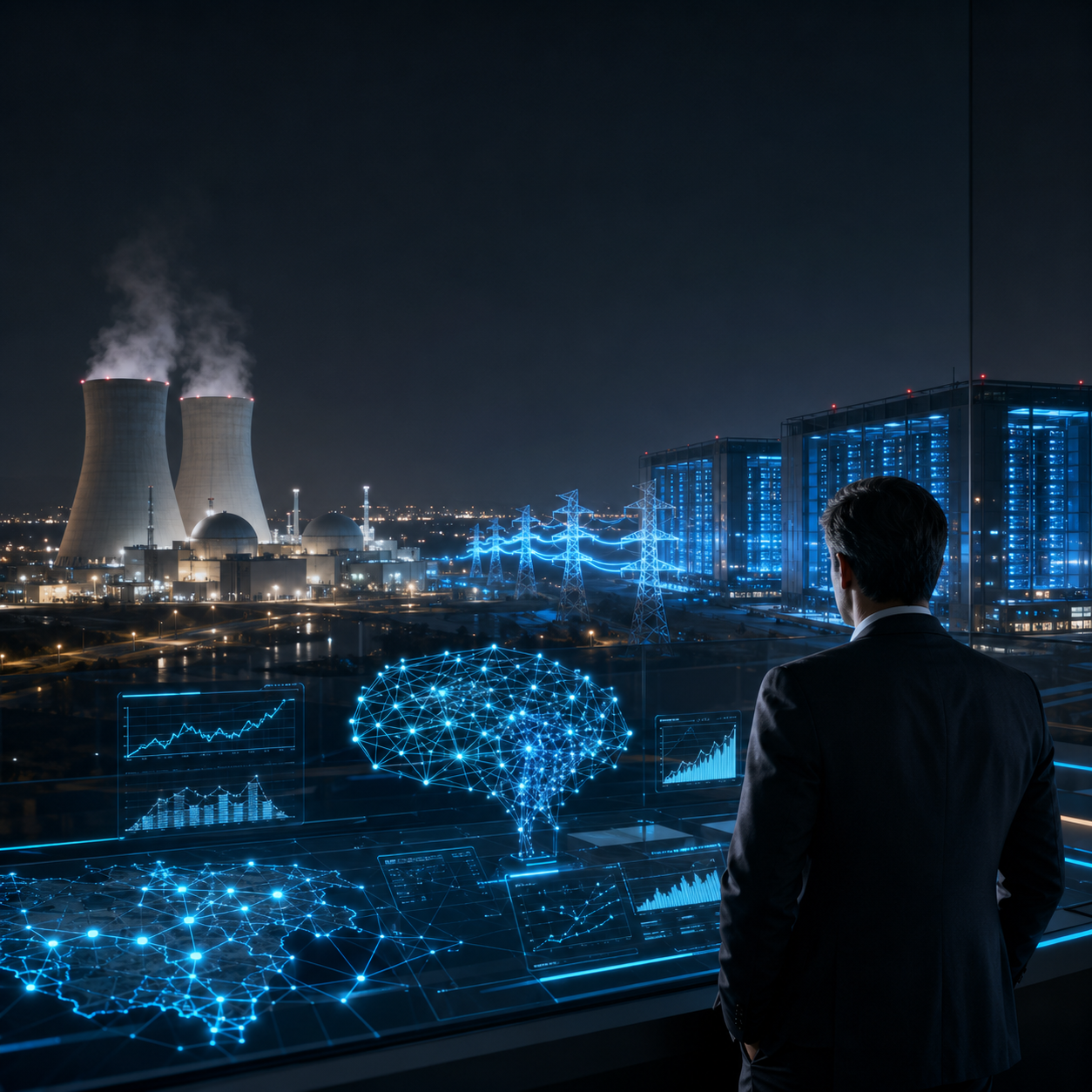
Today, some of the world’s largest technology companies are becoming long-term buyers of nuclear power—not because they want to own power plants, but because reliable electricity has become a strategic requirement for AI. Microsoft, Amazon, Google and Meta are no longer treating electricity as an operational cost. Increasingly, they are treating it as critical infrastructure.
That distinction matters.
For decades, the biggest challenge facing new nuclear projects was finding investors willing to commit billions of dollars before the first kilowatt-hour was produced. AI is introducing a new variable into that equation: customers with exceptionally strong balance sheets, predictable long-term demand and a willingness to sign multi-decade power agreements before projects are operational.
This is more than another chapter in the AI story. It represents a fundamental shift in how nuclear projects may be financed, developed and deployed over the next decade.
The Industry Is No Longer Solving an Electricity Problem
The common narrative is that AI simply requires more electricity.
That is true, but it misses the more important development.
The real constraint is not demand—it’s timing.
According to the International Energy Agency (IEA), global electricity consumption from data centres is expected to more than double by 2030, with AI becoming the primary driver of that growth. In advanced economies, data centres are projected to account for more than one-fifth of electricity demand growth this decade.
The problem is that AI infrastructure can be planned and deployed within two to three years, while a conventional nuclear plant often requires close to a decade from planning to commercial operation.
That mismatch is reshaping investment decisions across both industries. Technology companies are no longer asking how to buy electricity.
They are asking where future electricity will come from.
Big Tech Has Become a New Class of Nuclear Customer
The relationship between technology companies and nuclear energy has evolved rapidly over the past two years.
Microsoft’s agreement supporting the restart of Three Mile Island’s Unit 1—now the Crane Clean Energy Center—demonstrated that existing nuclear assets could become strategic infrastructure for AI.
Google followed with its agreement to procure power from Kairos Power’s advanced reactor programme.
Amazon expanded its nuclear strategy through investments in X-energy and partnerships linked to future reactor deployment.
Meta has since launched one of the industry’s largest requests for proposals for nuclear generation to support future AI infrastructure.
Viewed individually, these announcements appear to be corporate energy procurement decisions.
Taken together, they signal something much larger.
For the first time in decades, nuclear developers have access to a new category of customer capable of underpinning large-scale generation projects before construction begins.
That changes the commercial conversation.
AI Is Changing Nuclear Finance More Than Nuclear Technology
Most discussions about advanced nuclear focus on reactor design.
The larger disruption is occurring in project finance.
Historically, nuclear developments relied on government guarantees, regulated electricity markets or state-backed investment to reduce financial risk.
Hyperscalers introduce a different model.
Long-term electricity demand from companies with investment-grade credit profiles can improve revenue certainty, strengthen financing cases and reduce one of the biggest risks facing new nuclear developments: uncertainty over future power sales.
The value of these agreements extends beyond electricity.
They provide lenders with confidence that demand already exists before construction starts.
That is a powerful proposition for a sector where financing has traditionally been one of the greatest barriers to deployment.
Small Modular Reactors Have Found the Customer They Were Waiting For
Small Modular Reactors have often been presented as a technological evolution. AI may instead become their commercial catalyst.
SMRs have struggled to answer a fundamental question: who will commit to buying their electricity before the first reactor is built?
Hyperscale data centres provide a compelling answer.
Unlike traditional industrial consumers, AI campuses require continuous electricity, expand in predictable phases and typically operate over decades. Those characteristics align closely with the commercial model SMR developers have pursued for years.
The challenge now is less about identifying customers and more about delivering projects at the speed those customers require.
The Next Constraint Isn’t Reactor Technology
The nuclear sector often frames its biggest challenge as innovation.
The evidence increasingly points elsewhere.
The real constraint is industrial capacity.
Even if financing improves, project developers still face shortages across:
● Nuclear-grade manufacturing
● Heavy forgings and specialised components
● Uranium conversion and enrichment
● Transformers and high-voltage equipment
● Skilled engineering and construction labour
● Grid interconnection capacity
The IEA has warned that electricity infrastructure is becoming one of the principal bottlenecks for data centre expansion, with around one-fifth of planned projects potentially facing delays if grid constraints are not addressed.
This has important implications.
The companies that benefit most from AI-driven nuclear investment may not be reactor developers alone. Manufacturers, EPC contractors, fuel suppliers, transmission operators and equipment providers could become equally important beneficiaries of the next investment cycle.
Energy Security and AI Are Becoming the Same Conversation
For much of the past decade, nuclear energy was primarily discussed through the lens of decarbonisation.
That framing is changing.
Governments are increasingly linking energy security with economic competitiveness, while AI is turning reliable electricity into a strategic resource.
The convergence is difficult to ignore.
Countries seeking leadership in artificial intelligence will also need secure, resilient and scalable electricity systems. Those objectives are now reinforcing one another rather than competing.
For policymakers, supporting nuclear energy is becoming as much about enabling digital infrastructure as reducing emissions.
The New Competition Is for Reliable Power
The competition among hyperscalers is no longer limited to model performance or semiconductor supply.
It increasingly extends to electricity.
Companies that can secure reliable long-term power will be better positioned to expand AI infrastructure without being constrained by grid congestion or volatile wholesale markets.
That changes the role of energy procurement.
Electricity is no longer simply a utility service.
It is becoming a strategic input that influences where AI infrastructure is built, how quickly it can expand and which regions attract future investment.
For the nuclear industry, this creates an opportunity that extends well beyond reactor sales.
It positions nuclear generation as part of the infrastructure underpinning the next phase of the digital economy.
Executive Takeaway
The most important consequence of AI is not that it increases electricity demand. It is that it introduces a new class of electricity customer.
For decades, the economics of nuclear energy depended largely on governments and regulated utilities. Today, hyperscale technology companies are beginning to influence where reactors are built, how projects are financed and which parts of the nuclear supply chain receive investment.
That shift could prove as significant as any breakthrough in reactor technology.
The next chapter of nuclear energy will not be defined solely by engineering innovation. It will be shaped by a new generation of commercial customers that view reliable electricity as a competitive advantage rather than simply an operating expense.