
Artificial intelligence is rapidly becoming one of the largest new sources of electricity demand.
As hyperscale data centers continue to expand, utilities, technology companies and nuclear developers are searching for reliable sources of around-the-clock power that can scale alongside AI infrastructure. That shift is creating new commercial opportunities for advanced nuclear technologies that, until recently, remained largely confined to research programmes and pilot projects.
Against that backdrop, U.S. startup Ampera has unveiled what it describes as the world’s first subcritical, solid-state, factory-built thorium nuclear reactor. While the company has yet to generate electricity from the system, the announcement reflects a broader change taking place across the advanced nuclear sector: the conversation is moving beyond reactor concepts toward commercially deployable power solutions.
AI Is Reshaping the Advanced Nuclear Market
The rapid growth of AI infrastructure is changing how energy companies think about nuclear power.
Unlike many industrial facilities, AI data centers require uninterrupted, high-density electricity around the clock. Meeting that demand using conventional grid infrastructure alone is becoming increasingly difficult in several regions, prompting technology companies to explore dedicated power sources.
Major technology companies, including Microsoft, Google and Amazon, have all announced investments or partnerships involving advanced nuclear technologies to support future data
center growth. The result is a growing commercial market for next-generation reactors that can provide reliable, carbon-free baseload power.
For reactor developers, the opportunity is no longer theoretical. It is increasingly tied to one of the fastest-growing sources of electricity demand in the global economy.
Factory-Built Thorium Reactors Offer a Different Approach
Ampera’s reactor combines three concepts that have attracted growing attention across the advanced nuclear industry.
The design uses a subcritical thorium fuel system, a solid-state reactor architecture and a factory-built manufacturing model intended to improve operational safety while reducing construction complexity and deployment time.
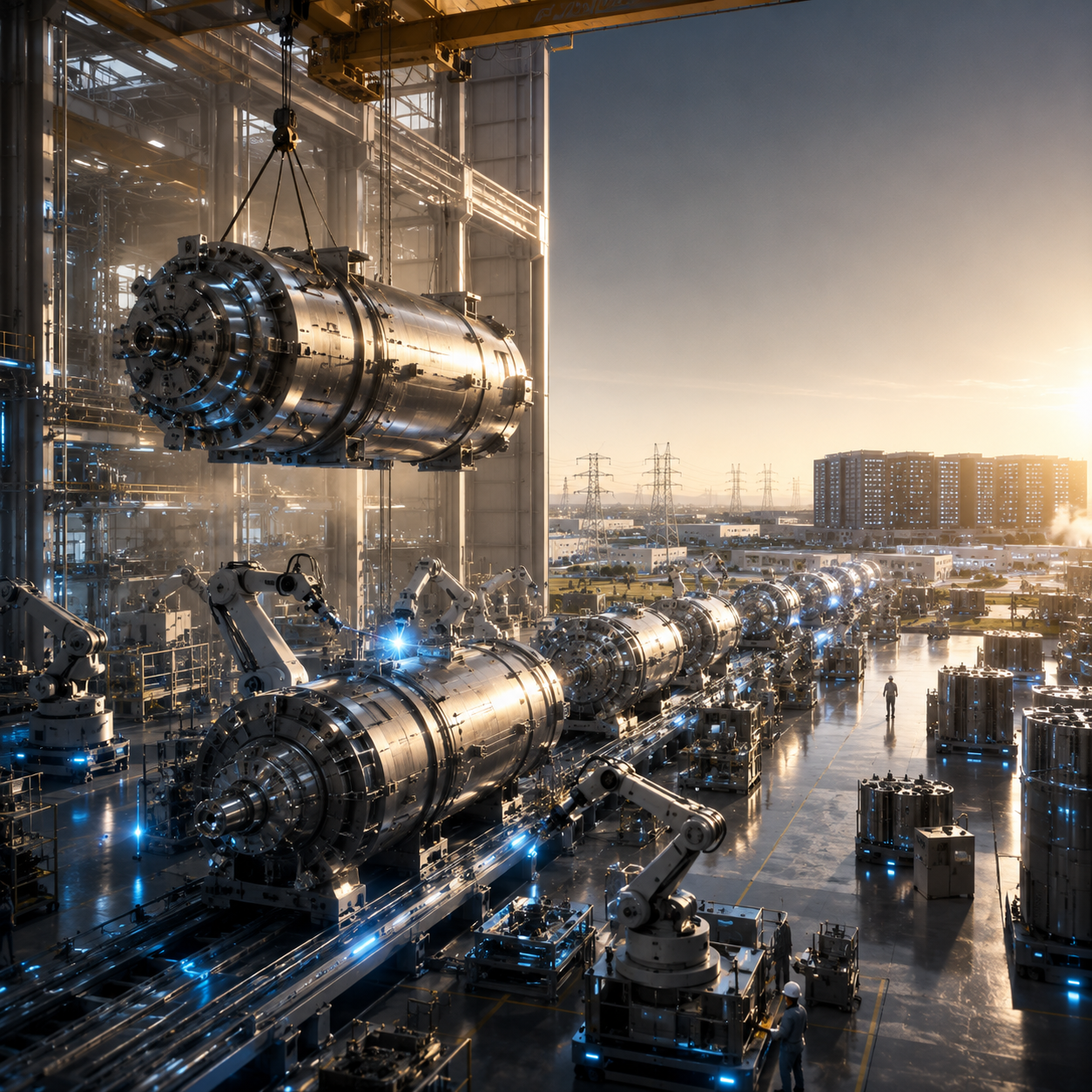
Instead of relying on large, site-built nuclear facilities, the company envisions manufacturing reactor modules in factories before transporting them to customer locations. If successfully commercialised, that approach could shorten project timelines, improve quality control and reduce construction risk.
The reactor is designed to operate as part of a modular energy platform that also incorporates a supercritical CO₂ Brayton-cycle turbine and optional waste heat recovery, allowing operators to improve overall system efficiency while supporting applications such as AI data centers, industrial facilities, defense infrastructure and maritime operations.
Why Thorium?
Thorium has long been viewed as a promising alternative nuclear fuel because of its abundance and potential fuel cycle advantages.
Although it is not directly fissile, thorium can be converted into usable nuclear fuel inside the reactor. Supporters also point to its potential safety benefits and lower long-term waste profile compared with conventional uranium-based systems.
While thorium has been discussed for decades, commercial deployment has remained limited. Growing electricity demand from AI may provide one of the strongest commercial drivers the technology has seen.
Commercialization Will Determine Success
Despite the engineering milestone, Ampera still faces the challenge that confronts every advanced nuclear developer: commercial execution.
The company has not yet demonstrated electricity generation from its thorium system or announced a deployment timeline. Its planned integrated platform targets approximately 30 MWe of generating capacity, but regulatory approvals, operational performance and customer adoption will ultimately determine whether the technology reaches commercial scale.
Across the advanced nuclear industry, investors are becoming increasingly focused on execution rather than concepts. Technologies that can demonstrate reliable performance, predictable deployment schedules and competitive project economics are likely to attract the greatest market interest.
What This Means for Energy Leaders
Ampera’s announcement is significant not simply because it introduces another reactor design, but because it reflects how rapidly electricity demand is changing.
AI is creating a commercial market for reliable, low-carbon power at a scale few anticipated only a few years ago. That demand is encouraging developers to rethink how nuclear technology is designed, manufactured and deployed.
Whether thorium ultimately becomes a mainstream nuclear fuel remains uncertain.
What is becoming increasingly clear is that the next generation of advanced nuclear companies will be judged less by the novelty of their reactor designs and more by their ability to deliver reliable electricity, secure regulatory approval and compete on commercial economics.
In the years ahead, the companies that can combine technological innovation with scalable manufacturing and dependable project execution are likely to shape the next chapter of the nuclear industry.