The fastest new nuclear megawatts in America are coming from reactors that already exist.
On October 27, 2026, the U.S. Department of Energy’s Office of Energy Dominance Financing announced a conditional loan commitment of up to $5 billion to Constellation Energy to finance uprates and modernisation across its nuclear fleet. The work spans eight plants in three states and, according to the Department of Energy, is expected to add nearly 1.1 gigawatts of electricity across the PJM and MISO grids, enough to power more than 930,000 homes.
For an industry that has spent years arguing about the cost of new build, the announcement points to a quieter and more immediate source of growth: squeezing more output from licensed sites with existing grid connections, trained workforces and decades of operating history.
Eight Plants, One Loan Structure
Constellation named the facilities under consideration. Six are in Illinois: Braidwood, Byron, Clinton, Dresden, LaSalle and Quad Cities. The others are Calvert Cliffs in Maryland and Limerick in Pennsylvania.
The commitment also carries an option to finance future uprate projects at additional Constellation facilities. That detail matters. It turns a single financing decision into a framework the company can return to as further projects mature.
The Department of Energy expects the programme to support more than 10,000 project-related jobs across the fleet.
“This conditional loan commitment can help us move faster and go further,” said Joe Dominguez, Constellation’s chairman, president and CEO, as reported by World Nuclear News.
Customer Contracts Built the Case First
The loan lands on top of commercial demand that was already in place. Constellation says 20-year agreements with Google and Amazon led it to commit more than $7 billion to add about 1,080 megawatts of nuclear capacity. A separate agreement with Meta supports a 30 megawatt expansion at Clinton in Illinois.
That sequence is the important part. Large energy buyers signed long-term offtake first, and federal financing followed to lower the cost of capital on the delivery.
For utilities and investors, uprates now have a recognisable capital stack: contracted revenue from creditworthy customers, combined with low-cost public debt.
World Nuclear News reports that the Office of Energy Dominance Financing has more than $289 billion in loan authority and can finance up to 80% of eligible nuclear uprate costs. A lender with that capacity changes the economics of projects that were always technically sound but competed for scarce capital inside utility budgets.
Uprates Have Become a National Capacity Programme
The Constellation loan sits inside a wider federal push. In March 2026 the Department of Energy launched its Utility Power Reactor Incremental Scaling Effort, known as UPRISE, aimed at 5 gigawatts of additional nuclear capacity by 2029 through life extensions, uprates and restarts. World Nuclear News reports an interim goal of 2.5 gigawatts by the end of 2027.
Energy Secretary Chris Wright framed the loan in those terms: “The Energy Department is accelerating President Trump’s American nuclear renaissance.”
The pipeline behind that goal is substantial. According to Environment + Energy Leader, citing the Nuclear Regulatory Commission’s list of expected applications, utilities anticipate about 30 uprate filings between late 2026 and 2032, totalling 7,336 megawatts thermal, or roughly 2,421 megawatts of electricity. Of those, 19 are extended uprates, 10 are measurement uncertainty recaptures and 2 are stretch uprates.
Constellation accounts for about a dozen units on that list, with its first extended uprate application expected in the fourth quarter of 2026. Duke Energy plans filings for Brunswick, McGuire and Catawba between 2027 and 2028. Southern Nuclear has Hatch listed for 2027 and the two older Vogtle units for late 2028.
Why Existing Reactors Win on Speed
Uprates are not new to American nuclear. The Nuclear Regulatory Commission had approved 171 of them as of January 2022, adding about 8,030 megawatts, according to Environment + Energy Leader. What has changed is the urgency of demand and the availability of finance.
The advantages over greenfield projects are clear:
- The site, licence and transmission connection already exist
- Regulators review a change to a known plant, not a new design
- Operators and maintenance crews are already in place
- Turbine, generator and instrumentation upgrades draw on a mature supplier base
- Capacity arrives years ahead of most new reactor timelines
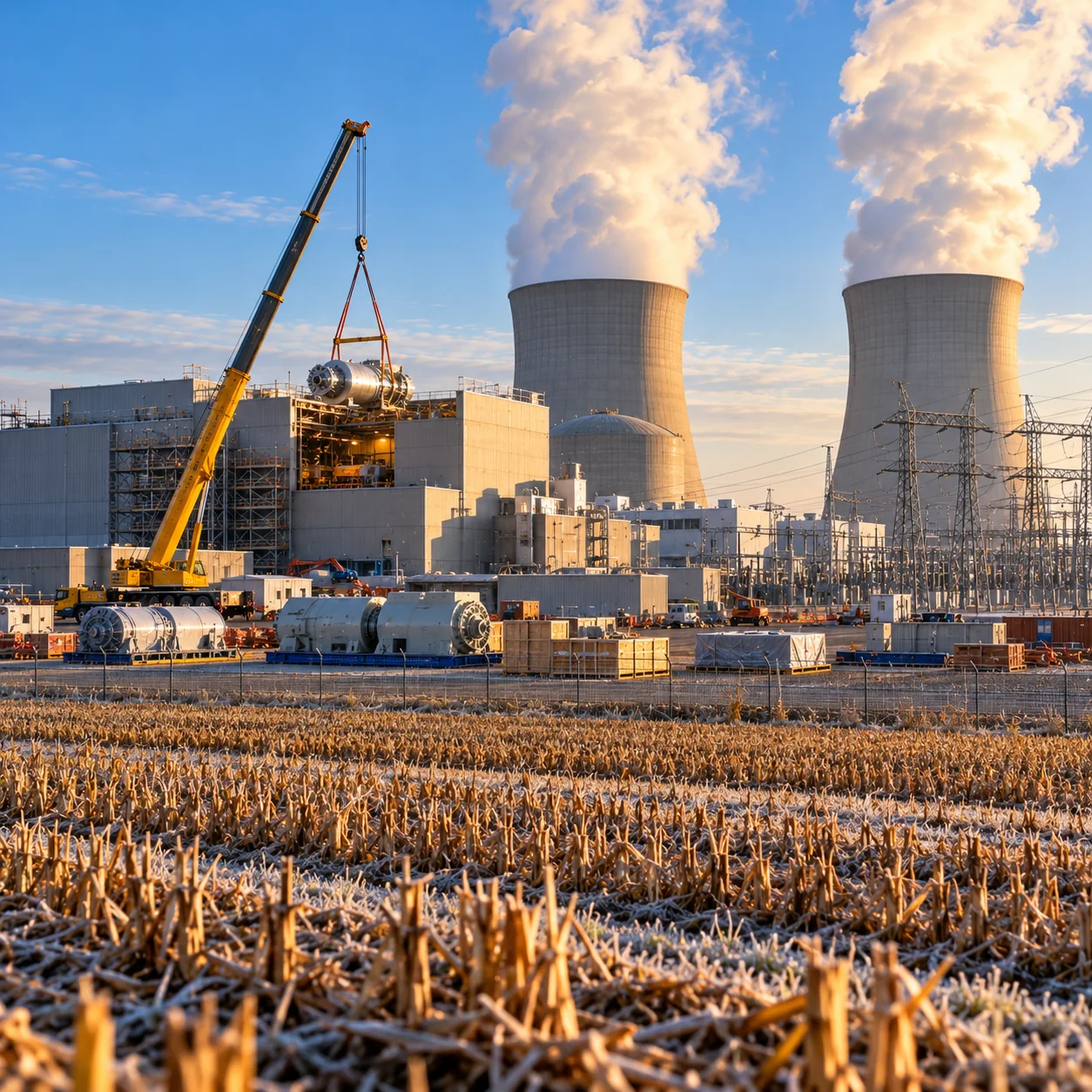
None of that makes uprates trivial. Extended uprates involve major component replacements, careful outage planning and detailed safety analysis. The financing now available simply means the queue can move at the speed of engineering and licensing rather than the speed of internal capital allocation.
What Comes Next for the Fleet
The commitment is conditional. Constellation must complete due diligence, negotiate definitive financing documents and meet technical, legal, environmental and financial conditions before the loan is funded. The company has also said the commitment does not by itself mean it will proceed with a specific uprate or at every facility under consideration.
The next markers are practical ones: definitive loan documents, the first extended uprate application reaching the Nuclear Regulatory Commission, and outage schedules that show when new megawatts reach the grid.
How quickly can the regulator process a wave of uprate filings?
How many other owners will follow Constellation into federal financing?
The answers will shape how much of the 5 gigawatt goal arrives on schedule. The direction, though, is set. Existing reactors are no longer treated as assets to be maintained. They are being financed as assets to be expanded.
New reactors will take years. The existing fleet is already getting bigger.