The paperwork for America’s next small modular reactors is now complete.
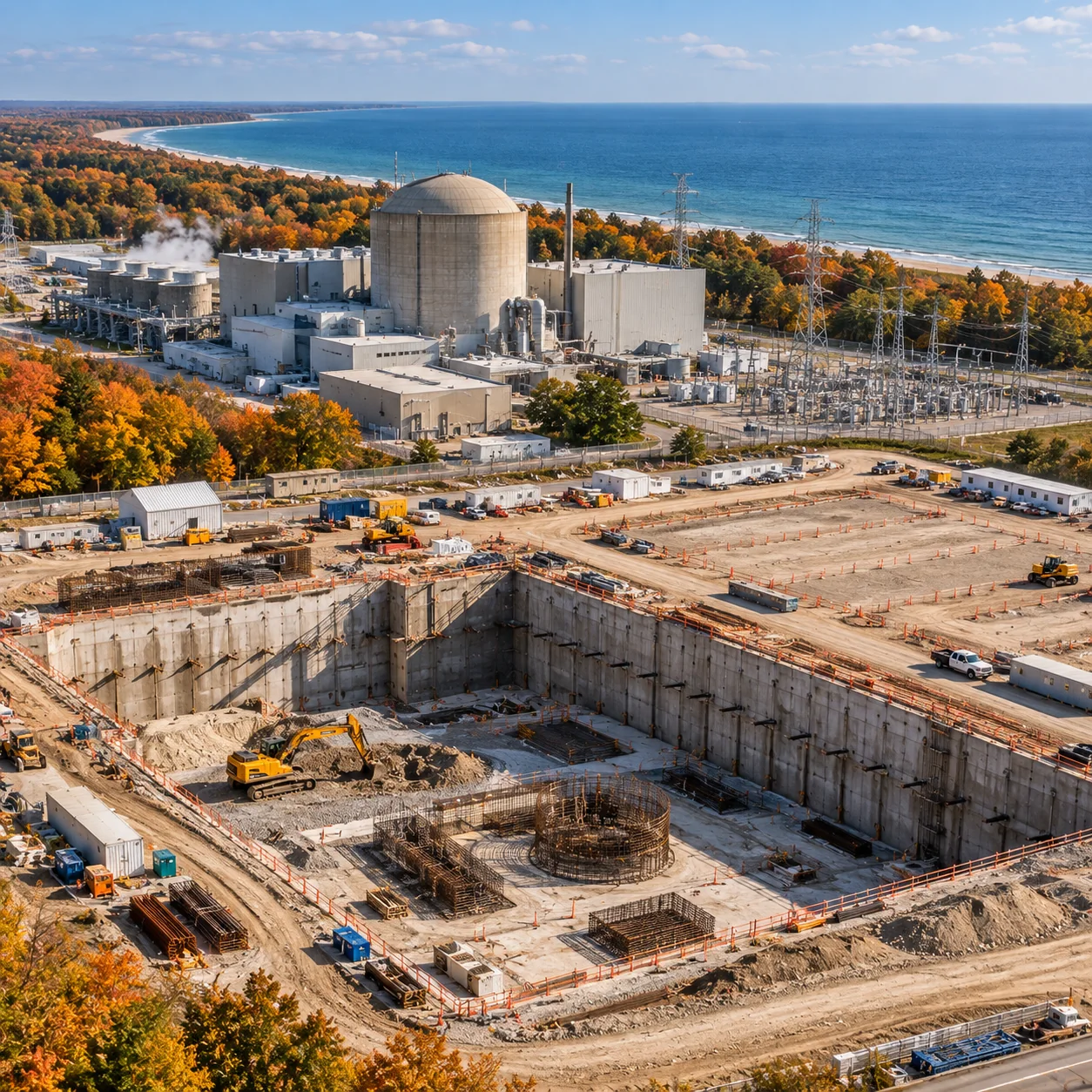
Holtec International has submitted the Preliminary Safety Analysis Report to the US Nuclear Regulatory Commission for Pioneer 1 and Pioneer 2, two SMR-300 units planned for the Palisades Energy Center in Covert Township, Michigan. According to World Nuclear News, which reported the filing on 2 October 2026, the submission completes the second and final part of Holtec’s construction permit application.
Holtec called it “the most significant step to date toward establishing the regulatory framework for the Pioneer plant.” The two units would add 680 MW of electricity to the regional grid, with operation targeted for the early 2030s.
For an industry that has spent years promising SMRs, a complete construction permit application for a named site is the kind of progress that counts.
A Two-Part Application Lands Well Inside Its Deadline
Holtec split its construction permit application in two. Part 1, filed in December 2025, carried a limited work authorisation request, exemption requests and the Environmental Report. The NRC accepted it for review and docketed it in February 2026.
When the NRC opened environmental scoping in June 2026, the American Nuclear Society reported that Holtec planned to file Part 2 no later than 18 months after Part 1, which pointed to mid-2027. The safety report arrived in early October 2026, months inside that window.
That timing matters.
The Preliminary Safety Analysis Report is where a developer sets out the design basis, the accident analysis and the safety case the regulator will test. With it on file, NRC staff can review the full application rather than working through it in pieces.
The Groundwork Has Been Moving in Parallel
The safety report did not arrive in isolation. Interesting Engineering reports that NRC staff audited and accepted an engineering report in September on a modular construction technique tested at Purdue University, with a formal safety evaluation expected by early November. The seismic assessment model was audited in September, and the digital instrumentation and control architecture was reviewed in August.
On 28 August, the NRC granted an exemption allowing Holtec to install permanent support-of-excavation and cutoff-wall systems for both units, according to World Nuclear News. Those include diaphragm walls, soldier-pile soil-mix walls and perimeter cutoff walls. Holtec expects the NRC’s draft Safety Evaluation Report on the limited work authorisation in December 2026.
For developers watching from other sites, the lesson is sequencing. Topical reports, exemptions and early site works can move on their own tracks while the main application is still being written. That compresses the calendar without skipping any step of the review.
Federal Money Is Built Into the Plan
The Pioneer project carries meaningful federal backing. In December 2025, Holtec announced that the Department of Energy had selected it for a $400 million Tier 1 First Mover award under the Generation III+ Small Modular Reactor Pathway to Deployment Program. Holtec says the support is milestone-based cost share aimed at licensing, pre-construction work and supply chain mobilisation.
The company also says it expects construction financing for the plant from the DOE Loan Programs Office. In its statement on the new filing, Holtec said it was “grateful for the US Department of Energy’s generous and timely support of the Pioneer deployment programme.”
Milestone-based funding rewards exactly the kind of progress the safety report represents. Each completed regulatory step makes the next tranche of capital easier to justify, for the government and for the private investors and power buyers who will eventually need to follow.
Why an Existing Nuclear Site Changes the Math
Palisades is not a greenfield site. It already hosts a large pressurised water reactor that closed in 2022 and that Holtec is working to return to service. The Pioneer units would sit beside it, turning the property into a multi-unit nuclear campus.
That configuration brings practical advantages that new entrants spend years trying to assemble elsewhere:
- Transmission connections at an established power site
- A host community already familiar with reactor operations
- Existing site characterisation and environmental data
- Security, emergency planning and operating experience on the property
- A local workforce with nuclear skills
The SMR-300 itself is a pressurised water reactor, the same broad technology family as most of the US fleet. World Nuclear News notes it can also supply about 1,050 MW of thermal power for process applications, which keeps industrial heat customers in view alongside grid electricity.
Kris Singh, chief executive and executive chairman of Holtec, described the DOE award as “validation of our 14-year quest to develop a walk-away-safe and cost-competitive nuclear reactor.” With the safety report filed, that claim now moves into formal regulatory review.
What Comes Next for Pioneer
Holtec has laid out its own next tasks. According to World Nuclear News, the company will complete a Class 2 construction estimate and a 4D simulation showing the plant’s construction step by step, and finish confirmatory safety analyses that will feed the Final Safety Analysis Report.
On the regulator’s side, the NRC must complete its safety evaluation and environmental review before a construction permit can be issued. The NRC is preparing an environmental impact statement, with the US Army Corps of Engineers as a cooperating agency, the American Nuclear Society reported. A separate operating licence application will follow once the units are built.
For utilities and large power buyers, the markers to watch are clear.
Does the draft evaluation of the limited work authorisation arrive in December as expected?
Does the Class 2 estimate land at a cost that supports long-term offtake contracts?
Positive answers to both would place Pioneer among the most mature SMR projects in the country, on a site that already knows how to run a reactor.
Restarts bring old capacity back. Pioneer will show whether the same sites can grow new capacity beside it.