Applied Atomics has picked a home, and it is betting on people as much as reactors.
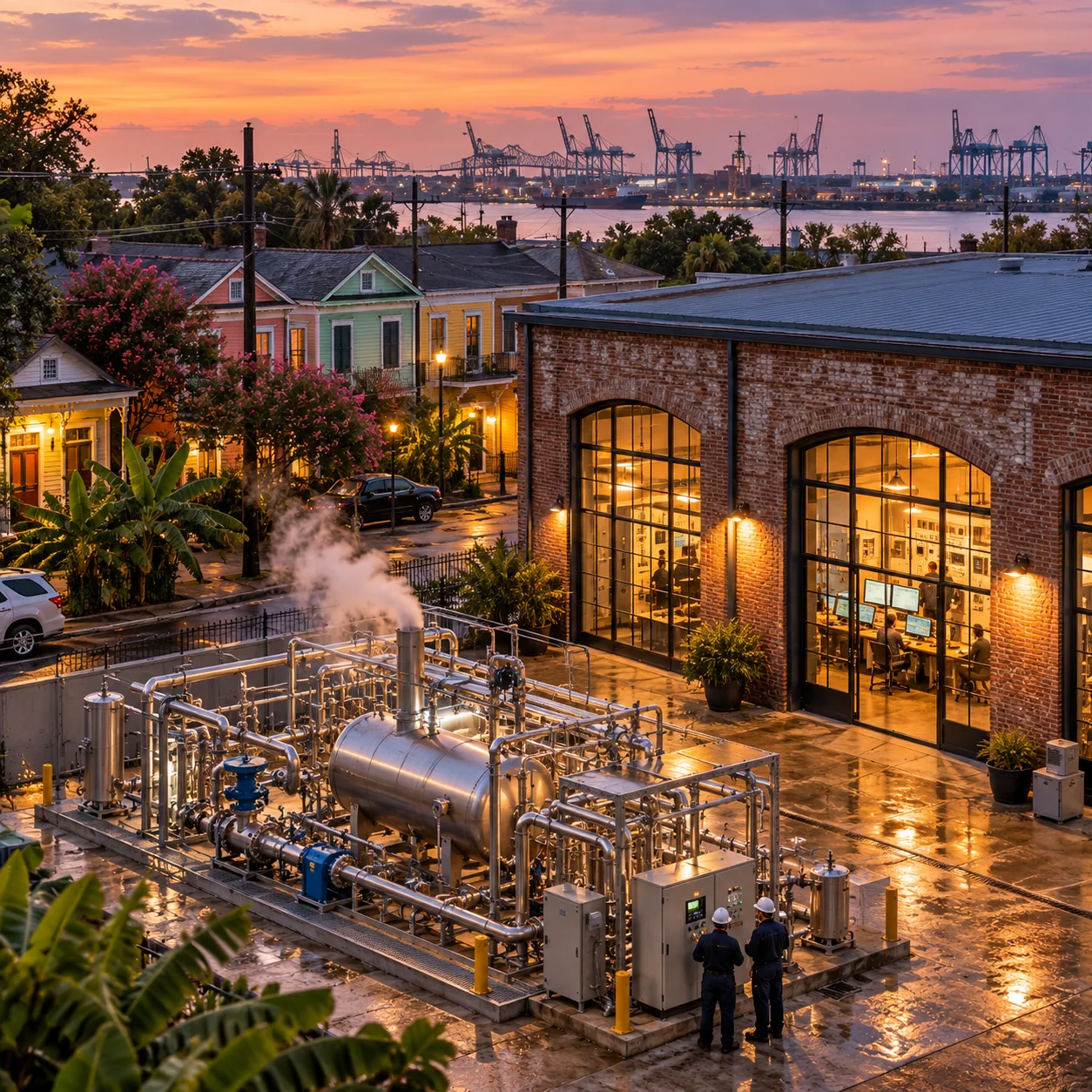
On September 23, the advanced nuclear developer announced it will invest $8.2 million to set up its headquarters and technical operations center in New Orleans, according to Louisiana Economic Development (LED). The facility covers about 18,500 square feet at 3333 Chartres Street in the Bywater neighborhood. It will hold corporate and technical offices, a light fabrication and component assembly shop, a control room and a training center.
The centerpiece is an outdoor “Plexiplant”, a subscale model of the company’s integrated power plant systems that runs on steam and electricity. LED says the company will use it for hands-on training of operators and technicians, and for equipment testing and technical development.
For a company founded in 2025, building a training plant before it builds a reactor tells you something.
A Developer That Plans to Own and Operate
According to LED, Applied Atomics develops, builds and operates small modular reactor power plants that range from 100 MWe to 1 GWe per deployment. Its target markets include data centers, synthetic fuels, water desalination, LNG processing and green hydrogen.
Its business model is not the same as a reactor vendor’s. When it announced its seed funding in March, the company said it plans to own and operate its plants and sell electricity under long-term power purchase agreements. It will use established light-water reactor architecture and put its plants alongside large infrastructure campuses. The company also said it was working with early customers to secure sites and agreements for the first 10 GW of planned capacity.
“Reliable power infrastructure must be designed, financed, built, and operated as a single integrated system,” chief executive Benjamin Kellie said at the time.
An owner-operator answers to its customers for decades, well beyond the day a plant is handed over. So the ability to run plants is a core asset, not something to sort out later.
Training Comes Before the First Reactor
Nuclear operators cannot be hired off the street. Licensed reactor operators and the technicians who support them take years to develop, and every new build in the United States will compete for the same small pool of experienced staff. A developer that waits for a construction permit before building its operating team may find that people, not hardware, set the schedule.
The Plexiplant tackles that problem early. With a subscale steam and electrical system, trainees can learn how a plant behaves, practise control room procedures and maintain equipment years before fuel arrives at any site. Engineers also get a place to test components and system integration before commercial deployment.
LED states plainly that the New Orleans site is not a nuclear power generation facility and that no radioactive materials will be handled, processed or stored there. That clarity helps with local acceptance, and it lets the company build on an ordinary commercial construction timeline. LED expects the interior buildout to finish by the end of 2026, the Plexiplant to start operating in the first quarter of 2027, and full training capability to be in place by the third quarter of 2027.
That is a fast timeline.
Why the Gulf Coast Makes Sense for Nuclear Talent
For a seed-stage company, the jobs numbers are significant. LED says the project will create 41 direct jobs paying an average of $121,000 a year, 79 percent above the Orleans Parish average. It estimates a further 141 indirect jobs, for a total of 182 new jobs in the region. The company is expected to use LED FastStart and to take part in the state’s High Impact Jobs program.
The choice of location reflects a practical view of where nuclear workers will come from. The Gulf Coast has a large workforce from refining, petrochemicals, LNG and power generation. These workers already understand steam systems, rotating equipment, process safety and shift operations. Several of the company’s target markets, including LNG processing and synthetic fuels, are clustered along the same coast.
LED Secretary Susan B. Bourgeois said Louisiana is intentionally building an environment where emerging technologies can move from ideas to commercial scale, creating high-wage careers and new opportunities for the state’s people and businesses along the way.
According to LED, Newlab New Orleans helped with the site evaluation and Greater New Orleans, Inc. acted as an economic development partner.
Workforce Is Becoming Part of the Infrastructure
Discussion of advanced nuclear tends to focus on reactor designs, licensing and financing. Workforce usually stays in the background as a problem for later. Applied Atomics is treating it as infrastructure, and that offers some lessons for other developers and their investors:
- Operator training capacity can be built well before licensing, at modest cost.
- Subscale systems also serve as test beds for components and plant integration.
- Siting near existing energy industries shortens the path to skilled hires.
- State workforce programs can share the cost of early training.
- Keeping non-nuclear facilities clearly separate from generation sites helps win local support.
Utilities and hyperscalers comparing SMR suppliers should also pay attention. A buyer that signs a power purchase agreement lasting decades is really buying operating performance. A developer that builds its operations team early is giving a credible signal of commitment.
Execution Is the Real Constraint
On its own, the New Orleans facility does not bring any reactor closer to a license. Applied Atomics still has to secure sites, customers and regulatory approvals for its first plants. It is also an early-stage company: its March announcement put total funding raised in its first year at $12 million.
Capital has never been the industry’s only bottleneck, though. As Ari Helgason of Transition, which co-led the seed round, said in March: “Affordable nuclear power has never been constrained by physics. It has been constrained by execution.”
Execution starts with people who know how to run a plant.
Reactors get the headlines. Operators keep the lights on.