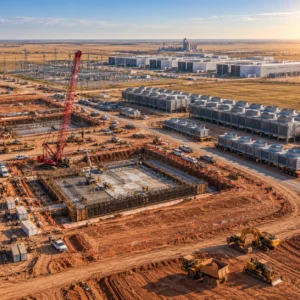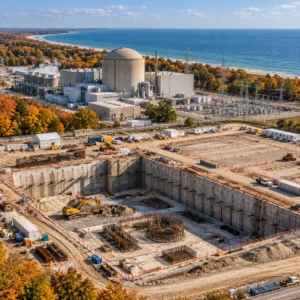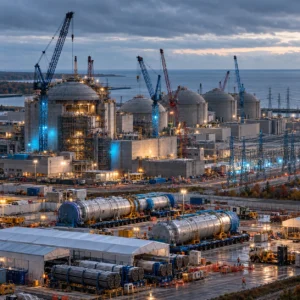
Indiana has no power-producing nuclear reactor inside its borders. On October 19, 2026, it put two very different plans on the table to change that.
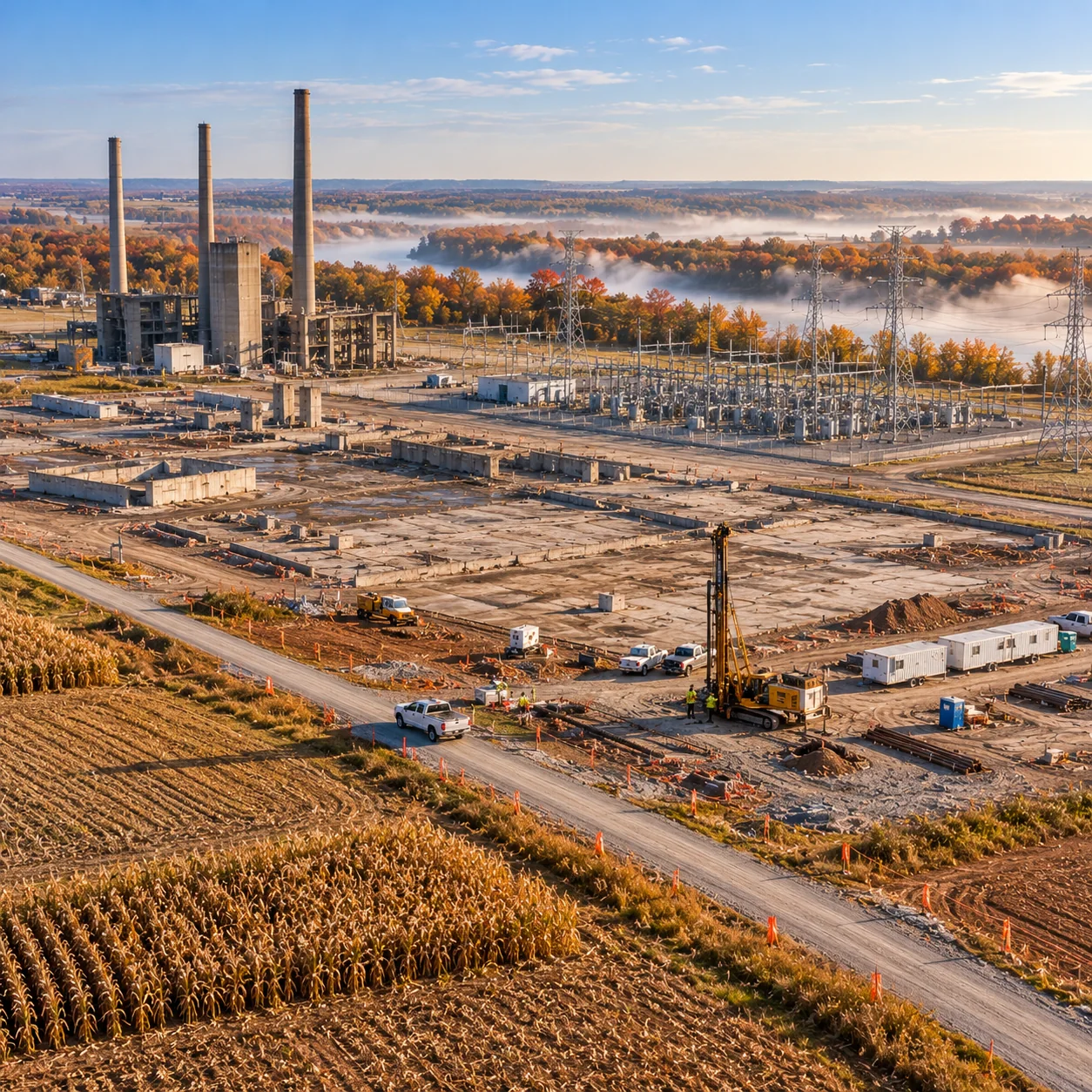
American Electric Power and X-energy signed a joint development agreement, with development funding from Amazon, to study a 960 MW plant of 12 Xe-100 small modular reactors at the site of the retired Breed Generating Station in Sullivan County. The same day, at an energy gathering hosted by Purdue University, Governor Mike Braun signed a nonbinding memorandum of understanding with Hoosier Energy Rural Electric Cooperative and AtkinsRéalis to study up to eight CANDU reactors and as much as 6 GW of new capacity.
Neither project has reached a final investment decision. Both are feasibility studies. But together they show a state that has spent more than a year preparing the ground, and is now seeing developers arrive with real proposals.
A State Strategy Is Turning Into a Project Pipeline
The scale stands out first. According to IndyStar, citing a December 2025 report from the Indiana Office of Energy Development, the state generates about 27 GW of electricity. The CANDU proposal alone would add more than 22 percent to that figure.
Those numbers did not appear by accident. X-energy points to Indiana policies passed since 2025, including investment and manufacturing tax credits, as part of the case for the Sullivan County site. The state’s Office of Energy Development has also launched what it calls a first-of-its-kind designation system for communities that want new nuclear, and in spring 2026 the governor signed a nonbinding letter of intent with Eli Lilly to explore nuclear supply, according to the American Nuclear Society.
Braun was direct about the ambition. “We do intend to be leading on this in the U.S., and I think we’re getting all our ducks in a row and just getting started,” he said, as reported by IndyStar.
Sullivan County Shows the Coal-to-Nuclear Model at Work
The AEP proposal follows a template the industry increasingly favours: reuse a retired coal site that already has land, transmission and a workforce that understands power generation. The Breed site is an AEP-owned brownfield, and the utility’s Indiana Michigan Power subsidiary has run the Cook nuclear plant in Michigan since 1975, so operating experience is already inside the company.
The commercial structure matters just as much. Amazon is providing what X-energy describes as milestone-based development capital, and if the project moves to construction and operation, Amazon intends to buy the output under a long-term contract. Amazon’s Josh Weissman said the company aims to “pay our full costs without passing them to others.”
That is the answer many regulators and ratepayer advocates have been waiting for.
The Sullivan County site is the third announced U.S. Xe-100 project, following the Dow project in Texas and the Cascade Advanced Energy Facility in Washington State, within a commercial pipeline X-energy puts at roughly 11.5 GW. The companies say construction could bring more than 1,000 jobs and more than 100 permanent positions, according to the American Nuclear Society.
CANDU Brings a Natural Uranium Option to the Midwest
The Hoosier Energy agreement adds a second technology path. CANDU reactors are pressurized heavy-water designs that run on natural uranium, so they avoid enrichment costs, and they can be refuelled while operating. AtkinsRéalis says 34 CANDU units operate across four continents, and in June 2026 it filed a notice of intent with the NRC to begin licensing the technology in the United States.
The partners are leaning into the multi-unit approach. They cite standardized design, repeatable construction, a sustained skilled workforce and a domestic supply chain as reasons to plan a fleet rather than a single plant. They are also evaluating gas turbines built ahead of the nuclear units, and gas-to-nuclear conversions at retired or retiring sites.
For Hoosier Energy, which serves more than 700,000 member-customers across central and southern Indiana and southeastern Illinois, the study fits what chief executive Donna Walker calls an “all-of-the-above” energy strategy.
Community Readiness Is the Quiet Advantage
Developers usually spend years earning local consent. Indiana is trying to shorten that work before a developer ever arrives.
The Indiana Advanced Nuclear Ready Communities Program, unveiled in summer 2026, lets a city, township or county earn one of three designations. The criteria step up from public education to proof of real preparation:
- Tier 1, Nuclear Aware: at least two public education meetings with time for questions
- Tier 2, Nuclear Prepared: a local government support resolution and utility letters
- A preliminary siting assessment covering zoning, transmission and water
- A workforce plan with college, university and K to 12 partners
- Tier 3, Nuclear Ready: engagement with NRC preapplication and early site permit work
- Signed agreements with a regional utility and an economic development strategy
The state presents the program as a way to reduce developer risk. Sullivan County already participates, according to Utility Dive, which means the first major SMR proposal in the state landed in a community that had chosen to raise its hand.
Purdue is building capacity of its own. It operates the only reactor in Indiana, a research unit, and named Seungjin Kim its first chief nuclear officer. Kim said community engagement will be essential, and predicted that once residents learn more, “their skepticism will turn into pride.”
What Comes Next for Developers and Utilities
The near-term work is siting, financing, licensing and environmental review. No cost, timeline or specific site has been set for the CANDU plan, and the Sullivan County study could still conclude that the project should not proceed. Those are the normal conditions of early-stage nuclear development.
What sets Indiana apart is the alignment around them. A governor willing to sign agreements, tax credits on the books, a community designation system, a university training pipeline and two utilities with different customer bases are all pointing in the same direction.
Which other state can put a coal-to-SMR fleet and a multi-gigawatt heavy-water plan into study on the same day?
Other states will be watching how quickly Indiana converts these memoranda into permit applications.
Indiana spent a year getting ready for nuclear. Now the developers are taking it up on the offer.